
If you want to see the Serengeti’s wildebeest calving, plan for the southern short-grass plains of Tanzania‘s Serengeti between late January and early March, with February usually the peak. The month matters, but the single biggest decision is where you stay. A beautiful camp in the wrong part of the Serengeti can mean long drives every day just to reach the herds.
This guide explains how the calving season works, how to choose a base, how many nights to plan and how to add a beach stay afterwards. If you are still deciding when to travel at all, our month-by-month guide to Kenya and Tanzania covers the whole year.
What happens during calving season
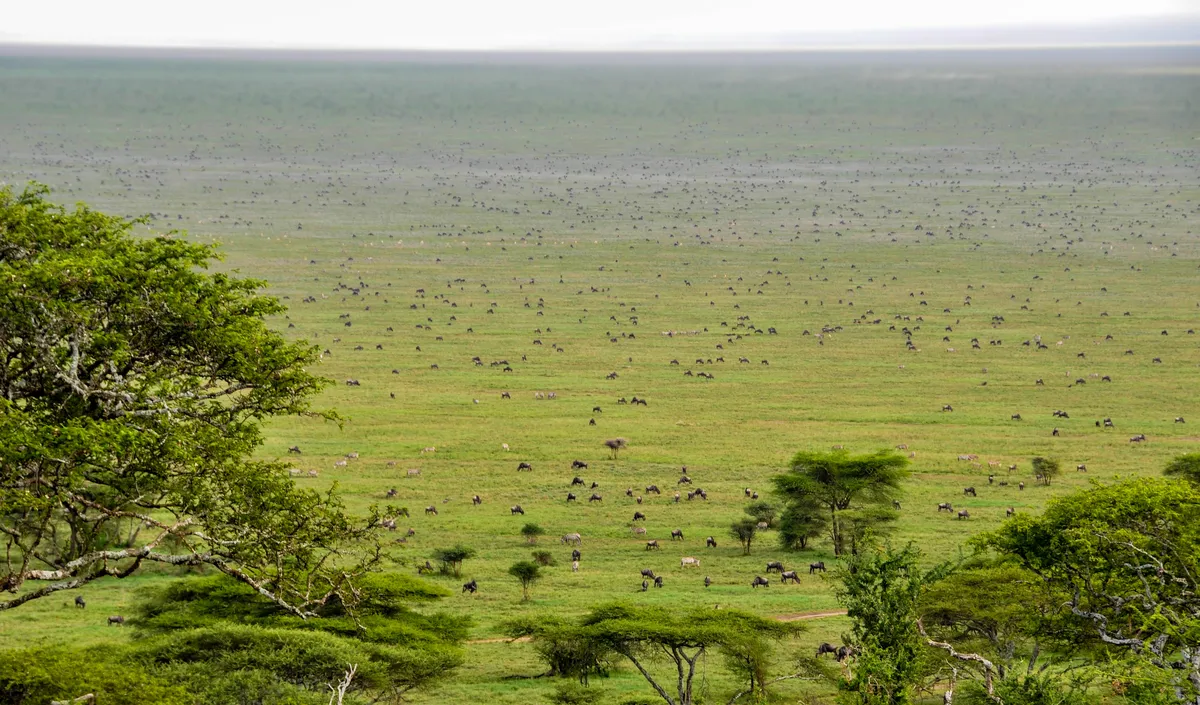
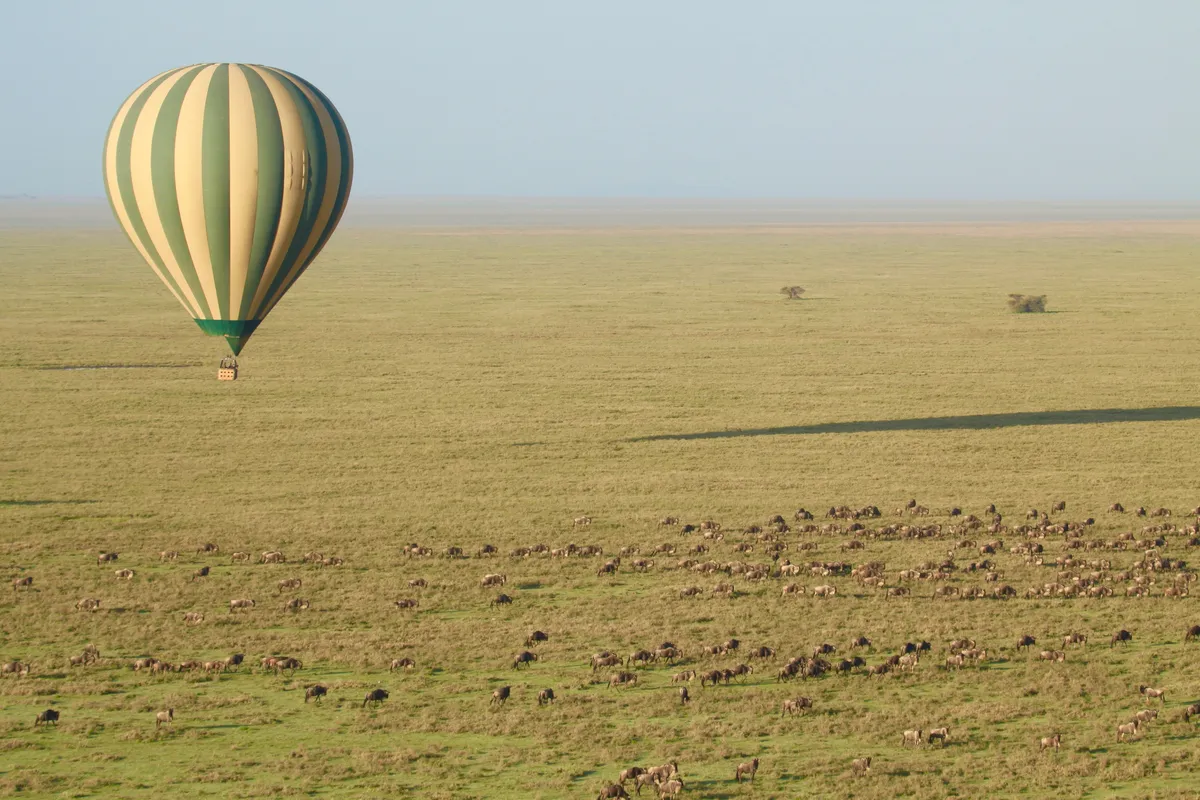
After the short rains of November and December, the herds of wildebeest and zebra move south onto the open plains that run from the southern Serengeti into the Ndutu area. The grass here is short and rich in nutrients, which is why the herds gather to give birth. Asilia, which runs a seasonal camp on these plains, says calving has usually begun by mid-January, peaks in February and often continues into early March.
With so many young animals on open ground, lion, cheetah and hyena are rarely far away. Days are spent watching calves find their feet within minutes of birth, herds moving across the horizon and predators working the edges. It is intense, and some moments are hard to watch, which is worth knowing before you go.
Calving is not the river crossing
The famous Mara River crossings happen in the northern Serengeti and Kenya’s Maasai Mara, usually from around July to October. Calving is a different experience in a different place: wide open plains, newborns and predators, rather than rivers and steep banks. Many guests eventually see both, on separate trips planned for different months.
Where calving happens: the southern plains and Ndutu
The calving grounds do not stop at a park boundary. They stretch across the southern part of Serengeti National Park and into the Ndutu area, which lies within the Ngorongoro Conservation Area. The two are managed by different authorities with their own fees and rules, and the herds move freely between them, following rain and fresh grass. Their exact position can shift from week to week, so a good guide watches the conditions daily rather than relying on a map.
This is why we always talk about the area first and the camp second. Camps in the central, northern or western Serengeti may be excellent at other times of year, but between January and March many of them are a long drive from the herds.
January, February or early March?
| When | What usually happens | Worth knowing |
|---|---|---|
| January | The herds are settling on the southern plains and calving has usually begun by the middle of the month. | Asilia describes January as usually warm and dry, with an occasional shower. A good choice if your dates are fixed early in the year. |
| February | The peak of calving, with the most births and high predator activity. | The most requested month, so preferred camps and family tents fill first. |
| Early March | Calving often continues and young calves are still on the plains. | The long rains approach, some seasonal camps close in mid-March, and some camps move to lower seasonal rates from 1 March. |
So is February always best? Not always. The herds follow the rain, and every year is a little different. February gives you the best odds, but late January and the first days of March can be just as rewarding, and they often give you more choice of camps. If you have some flexibility, tell us, because a few days either way can open up a better location.
How we choose a base
When we plan a calving safari, we work through four questions in this order:
- Where are the herds likely to be on your dates? We look for a camp positioned on or near the short-grass plains for that part of the season.
- Is the camp actually open and in its southern location? Seasonal camps move, and their dates differ. We check each camp’s current operating dates rather than assuming.
- What guiding suits you? Some camps include shared game drives, while others expect you to arrive with your own guide and vehicle. A private vehicle lets you stay as long as you like at a sighting, which matters for photographers and families.
- What level of comfort do you want? A mobile camp puts you close to the action with simpler facilities. A permanent lodge offers more, such as a pool or spa, but may be further from the herds.
To show why location matters, consider Asilia’s Namiri Plains, a lovely permanent camp in the eastern Serengeti known for big cats. Asilia itself notes that from November to May the herds are reachable from there on longer game drives but are typically not close to camp. It is a strong choice for many trips, but not usually our first suggestion for guests whose main goal is calving.
Three examples on the calving plains
These three camps show the range of styles on the plains: a mobile camp with shared game drives included, a camp suited to guests travelling with their own private guide, and the most indulgent of the three, with a private butler.
Ubuntu Migration Camp is Asilia’s mobile camp. From mid-December to mid-March it sits on a hillside in the Kusini area of the southern Serengeti, then moves north for the river crossing season. It has ten tents, including one family tent that sleeps four, welcomes children from five years old and uses traditional bucket showers. The closest airstrip in the south is Serengeti South, about 90 minutes’ drive away, and shared game drives are included.
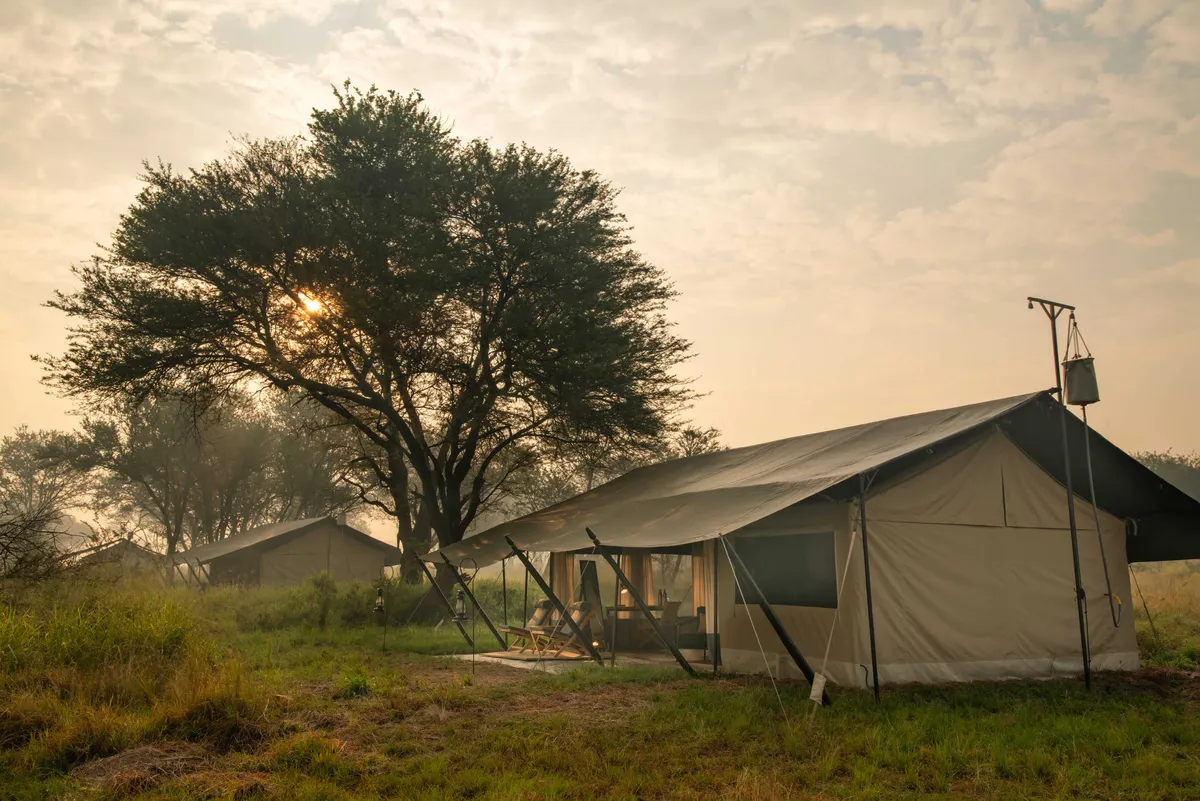
Lemala Ndutu is a seasonal camp in the Ndutu area of the Ngorongoro Conservation Area, set on the edge of a permanent marsh. Lemala lists it as open for the calving season, from December to the end of March, with eight tents and two two-bedroom tents for families and friends. Ndutu airstrip is about 20 minutes away. Game drives, the vehicle and guide are arranged separately, which suits guests travelling with a private guide.
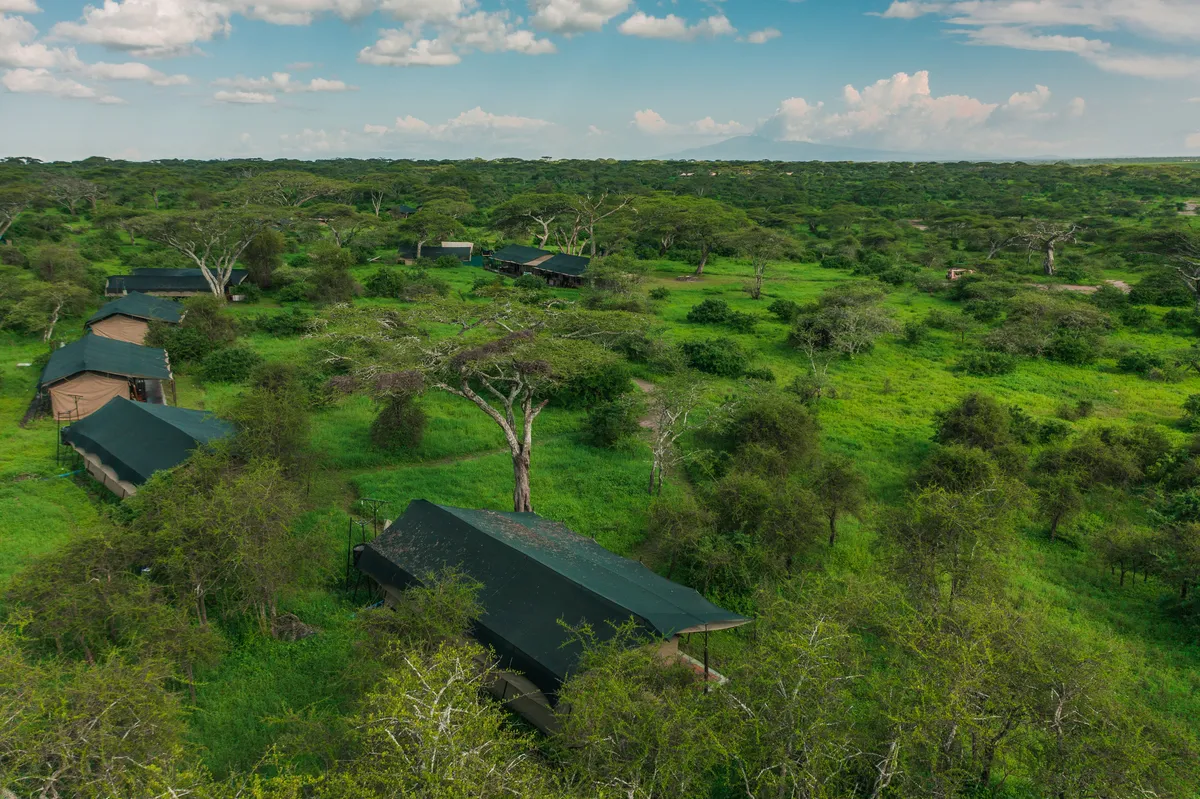
&Beyond Serengeti Under Canvas is a mobile camp on private campsites that moves around the Serengeti through the year to stay close to the herds. From January to March, &Beyond places it in the south for the calving season, and its brochure points to the Ndutu area. There are two camps of nine tents each, including one family tent for two adults and two children, and every tent has an en-suite flushing toilet and an outdoor heated bucket shower. A private butler takes care of the details of each day, and dinner is served with crystal and silver. Meals, most drinks, twice-daily game drives, laundry and transfers from the airstrip are included, and a private vehicle can be added at extra cost, subject to availability. Children are welcome from six years old. &Beyond works with Wild Impact, formerly Africa Foundation, its long-standing community and conservation partner, and in Tanzania it supports lion conservation, including the Serengeti De-Snaring Programme.
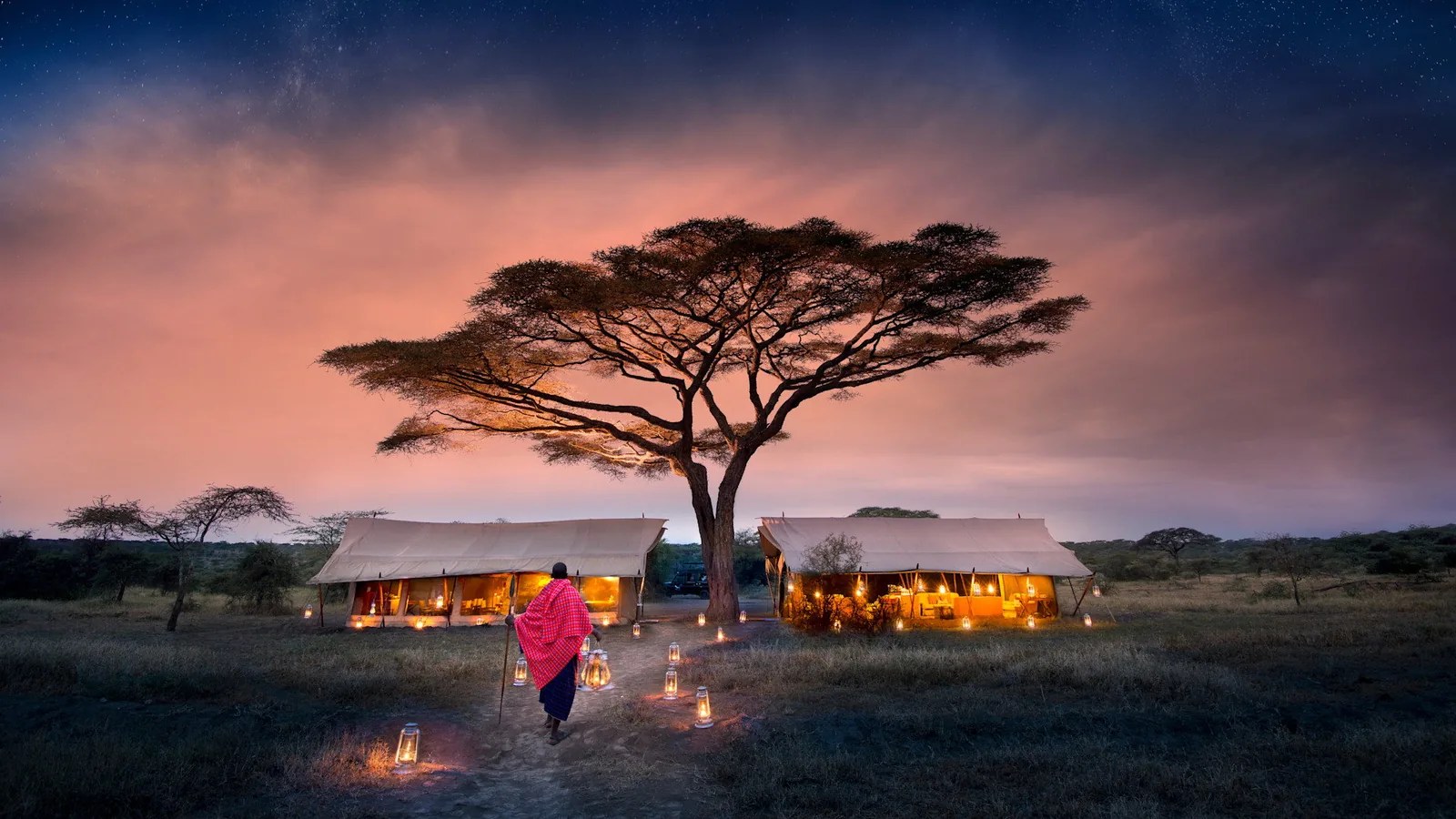
These are three examples, not the only good options. We choose camps for their guiding and location, and for how they support local communities and protect the wilderness around them.
Mobile camps and permanent lodges
Mobile camps are the classic way to see calving. They are set up for the season close to where the herds tend to gather, then packed down and moved. Tents are spacious and comfortable, with proper beds and en-suite bathrooms, but expect canvas walls, solar power and, at some camps, a bucket shower filled with hot water on request. Most guests find this part of the charm.
Permanent lodges have more solid rooms and often more facilities. In the Ndutu area there are long-established permanent lodges, such as Ndutu Safari Lodge with its stone and thatch cottages overlooking Lake Ndutu. Whether a permanent lodge works for calving depends entirely on where it sits in relation to the herds that season.
How many nights are worthwhile?
We suggest at least three nights on the calving plains, and four if you can. The herds can move, the weather can change, and a full-day game drive with a picnic lunch is often the best way to follow them. Staying longer in one place also means fewer packing days and more time simply watching.
An illustrative six-night structure
This is an example to show the shape of a trip. It is not a booked itinerary, and every journey is adjusted to your dates, camp availability and flight schedules.
- Night 1: Arrive at Kilimanjaro International Airport and rest near Arusha after the long-haul flight.
- Nights 2 to 5: Light aircraft to the Ndutu or Serengeti South airstrip, then four nights at a camp on the calving plains, with at least one full-day game drive.
- Night 6: One night in the Ngorongoro highlands, with a morning in the Ngorongoro Crater before flying out, or continue to the coast.
For five nights, drop the highlands night. For seven, add a second camp in another part of the Serengeti or extend your time on the plains.
Photography and ballooning
The short grass gives clear views across the plains, and February often brings good light with less dust than the dry months. For serious photographers, a private vehicle is usually worth it: you choose your position, stay with a sighting and decide when to move on. Good guides keep a respectful distance from births and hunts, and they follow the rules of the park or conservation area you are in.
Hot-air balloon flights operate over the southern Serengeti in season and give a remarkable sense of how far the herds spread. They are usually booked separately and depend on weather, so we confirm them when we plan your camp.
Getting there and getting around
Most guests fly into Kilimanjaro International Airport and connect by light aircraft to the southern airstrips. Coastal Aviation’s published schedule lists daily flights to the Ndutu and Serengeti South airstrips, usually with stops along the way. Standard luggage on these flights is 15 kg per person in a soft bag, and Coastal offers an extra-allowance seat that must be confirmed in advance. Check the drive from the airstrip too: it can be 20 minutes to one camp and 90 minutes to another.
From North America and Europe, the journey usually means a long-haul flight and a connection, so a rest night on arrival is worth it. From the Gulf, flights are shorter, but the same rule applies: arrive rested before your first early game drive.
Adding Zanzibar
Calving combines naturally with a beach stay on Zanzibar. Coastal Aviation’s published schedule shows daily flights between the southern Serengeti airstrips and Zanzibar, routed via Arusha, so you can move from the plains to the coast in a day without returning to Kilimanjaro. Three to five nights on the coast is a relaxed end to a safari. Our honeymoon safari guide has more ideas for combining safari and beach.
Planning now for January to March 2027
November is already short notice for some preferred camps in February, and family tents are often the first to go, because many camps have only one or two. If you are travelling with children, our luxury family safari planning guide covers rooms, ages and how many nights to stay in each place. That does not mean you have missed the season. Being flexible on dates or camps by even a few days often makes a real difference, and we check live availability across several suitable camps before suggesting anything.
Our team works across Dubai, the United States and South Africa, so we can plan around your time zone. Share your travel window, how flexible you are, who is travelling and the comfort level you prefer through Design My Safari, and we will come back with the camps that fit.
Frequently asked questions
When is the Serengeti calving season?
Calving usually begins around mid-January, peaks in February and often continues into early March, on the short-grass plains of the southern Serengeti and the Ndutu area. Timing varies with the rains each year.
Is February always the best month?
February usually has the most births, but it is not guaranteed. Late January and early March can be excellent, and often offer more choice of camps.
Where should we stay for calving?
Stay on or near the southern plains, at a seasonal camp in its southern location or a lodge well placed for that season. Not every Serengeti camp offers easy access to the calving area.
How many nights should we spend on the calving plains?
At least three nights, and ideally four, so you can follow the herds if they move and enjoy a full-day game drive.
Can we combine a calving safari with Zanzibar?
Yes. Scheduled light aircraft link the southern Serengeti airstrips with Zanzibar via Arusha, so you can fly from the plains to the coast in a single day.
Is calving season the same as the Great Migration?
Yes, it is one part of it. The Great Migration is the year-round movement of the wildebeest and zebra herds through the Serengeti and Maasai Mara. Calving is the part from about January to March, when the herds are on the southern plains. The Mara River crossings happen later, usually July to October. Our month-by-month guide covers the whole year.
Is a calving safari suitable for children?
It can be, for older children who are comfortable with long game drives and who are prepared for predators hunting young animals. Some camps set minimum ages, so we choose camps that suit your family. Our family safari guide has more on ages and pacing.
Sources
- Asilia Africa, Ubuntu Migration Camp and Namiri Plains. Checked 11 November 2026.
- Lemala Camps and Lodges, Lemala Mara and Ndutu Tented Camps and rates and season dates. Checked 11 November 2026.
- Ndutu Safari Lodge, Ndutu Safari Lodge and Migration. Checked 11 November 2026.
- &Beyond, Serengeti Under Canvas, its about and accommodation and conditions pages, and the lodge brochure. Checked 16 November 2026.
- Coastal Aviation, Flights timetable to 31 May 2027, updated September 2026. Checked 11 November 2026.